

In the board game community, we often talk about gateway games: they’re fun, easy(ish) to learn and teach, and great ways to introduce people to the hobby. The four classics you most often hear about are Settlers of Catan, Carcassonne, Pandemic and Ticket to Ride. Newer entries might include Champions of Midgard, Love Letter, The Quest for El Dorado and Skull.
Lots of choices, then, across a variety of themes and genres. But what about tabletop roleplaying games? What’s the best one for people new to the hobby? What game could you recommend that’s inexpensive, easy to learn, and, most importantly, easy to run for brand new Game Master?
The best answer isn’t Dungeons and Dragons, though it’s the most popular. You could get away with learning the game based solely on the 300-plus page Player’s Handbook, but the 300-plus page Dungeon Master’s Guide has some important guidance on running the game, while the 300-plus page Monster Manual has the monsters the players will actually encounter, plus story hooks to help work them into an adventure. Oh, and many of the monsters have complicated stat blocks including spells that are described … in the Player’s Handbook.
If you’re a psyho nerd like me, you can spend a couple weeks reading through those books, and finding further advice online, and feeling something close to confident about being able to run a session. And in fairness, starter sets like the Lost Mines of Phandelver do a great job introducing the basic rules in a classic fantasy adventure.
However. That’s not the same thing as picking up Ticket to Ride at your friendly local game store after work and sitting down to play with your friends that evening. So what if I told you there’s a great and free fantasy roleplaying game that requires minimal preparation?
Friends, let me spread the gospel of Homebrew World.
Weird name, right? Here’s the story. A groundbreaking RPG called Apocalypse World was published in 2010, inspiring a long line of games with similar rules known as Powered by the Apocalypse. One of these was Dungeon World, a fantasy game in the tradition of Dungeons and Dragons, released in 2012. In 2018, designer Jeremy Strandberg released Homebrew World, his stripped down version of Dungeon World. It’s just four pages of basic rules and a bunch of simple yet thematic character classes, and you can download it for free on his blog.
Homebrew World and other PbtA games are so easy to play because the moves a character can do explain what happens on a given roll of the dice. Unlike traditional games like Dungeons and Dragons, when you try to do something, you don’t roll against a target number set by the Game Master. Instead, you roll 2d6 plus a modifier and hope to meet certain thresholds: 6 or less is a failure, 7-9 is a mixed success, and 10+ is a total success. Let’s look at the basic moves:
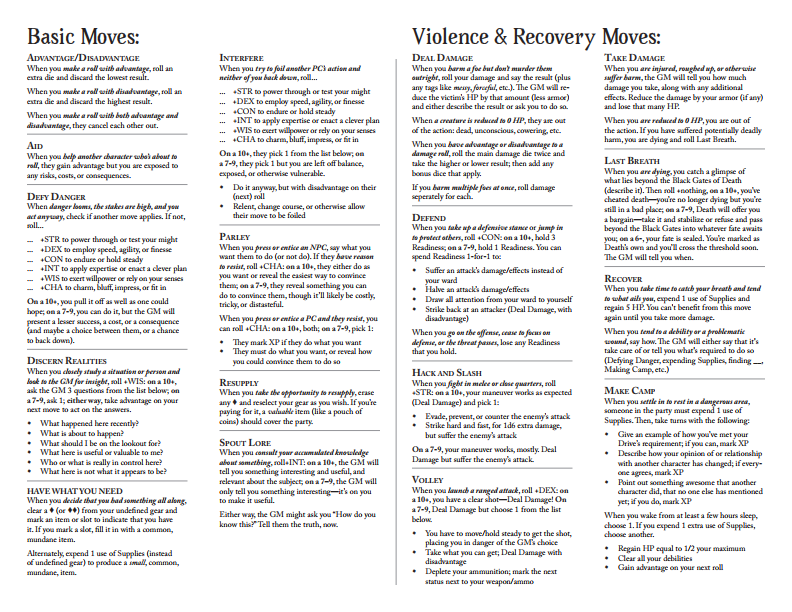
What happens when you roll a 7 to convince the town guard to let you investigate the scene of the theft? You don’t need to look up the rules on social interactions, they’re right there in the Parley move itself! The Game Master just has to improvise what the guard needs to grease the wheels.
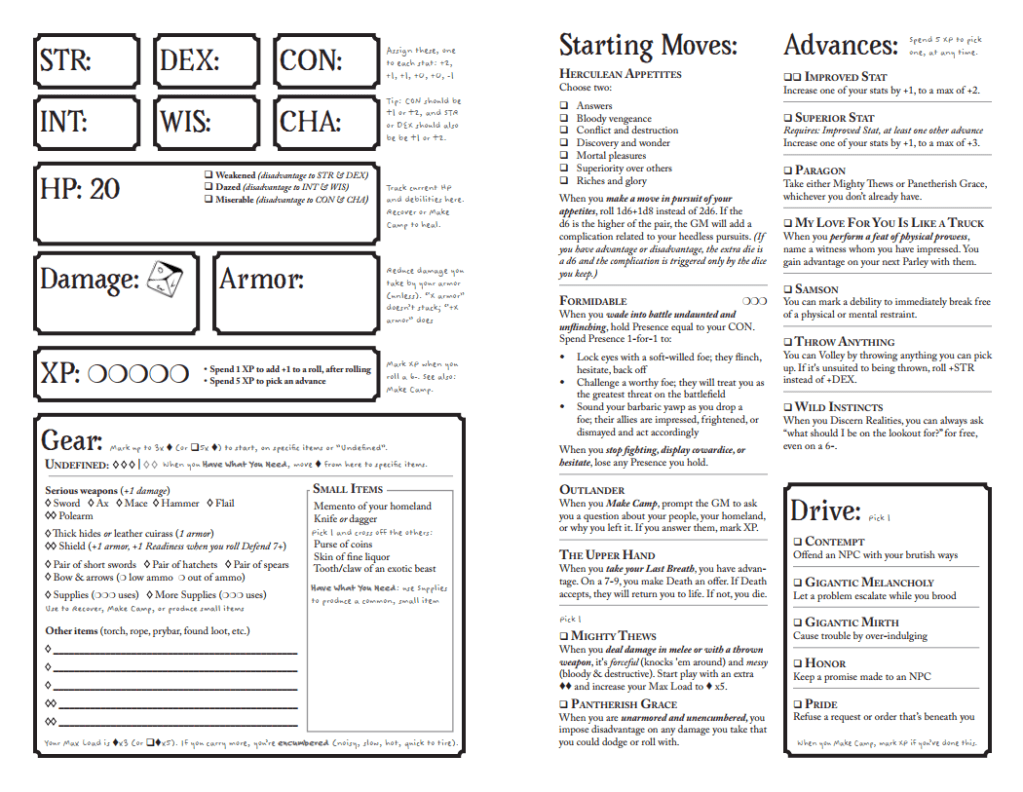
And here’s a character sheet. Look how simple it is! Your party will be able to set forth for adventure just five minutes after sitting down at the table.
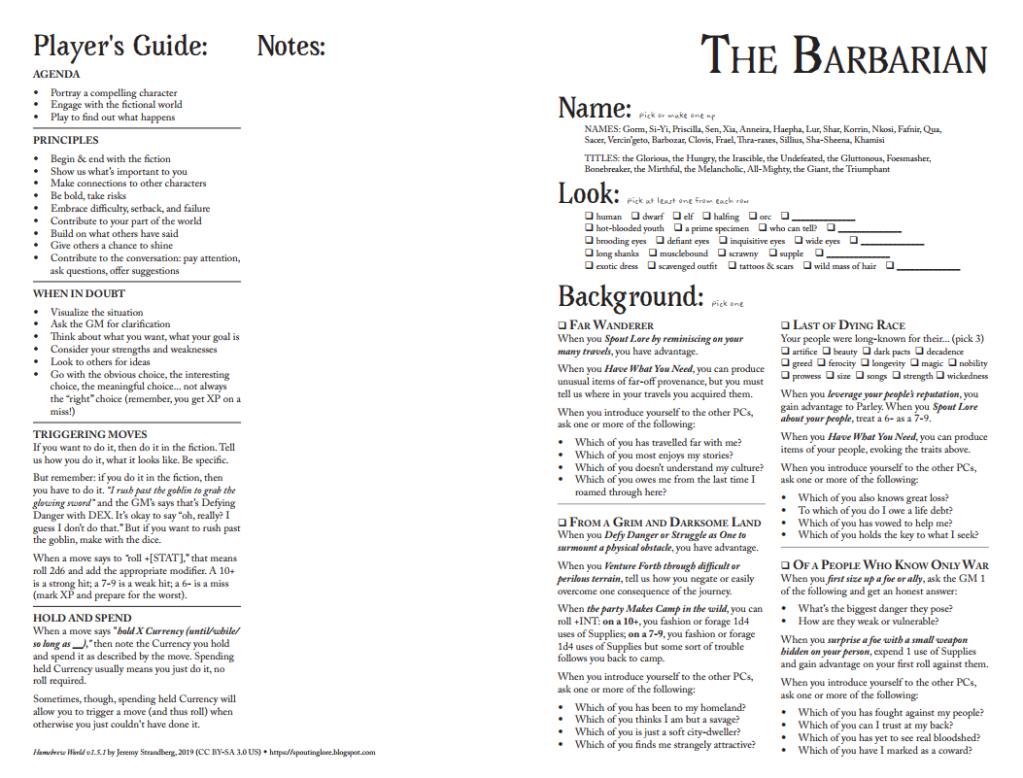
Strandberg also includes some guidance on how to whip up some monsters and adventures with minimal preparation. Though if you have $5 to spend, I’d recommend the 20 Dungeon Starters booklet. I’ve used a couple of those scenarios, and they were a blast.
At this point, some of you are probably screaming about Monster of the Week and other PbtA games, or Blades in the Dark, or one of the many Old School Renaissance-style games. Those are great simple(ish) RPGs – Monster of the Week was actually the first RPG I ever ran – but none are as simple, or free, as Homebrew World. This is about getting a group of RPG newcomers playing now, with as few rules to get stuck in their teeth as possible.
For that, Homebrew World rolls a natural 20. (Well technically a 10+ but you get the point.)
And if playing it leaves you wanting more, keep an eye on Strandberg’s ambitious next project, Stonetop.
 Into the Fray