

I’m not going to waste time with a fancy introduction today. 13th Age is a heroic fantasy role-playing game that combines classic swords-and-sorcery high adventure with elegant storytelling mechanics that bring your character and the world to life.
Here are the highlights, courtesy of the 13th Age public rules reference:
- Icons – Icons are powerful factions that exert their will on the realm in some way or another.
- Relationships – A quantitative measurement of how much influence a given Icon exerts on a character.
- Backgrounds – Instead of advancing individual skills, a character assigns points to jobs or positions they have held, which can help them with actions in-game.
- One Unique Thing – Every player character has one unique thing about them that separates them from every other individual in the campaign’s universe. This defines both the character and the universe by exclusion.
13th Age also eschews grid- and numerical-distance-based mechanics in favor of simplified range mechanics. Two characters are either:
- “Engaged” – In direct melee combat
- “Nearby” – Within one move away
- “Far-away” – More than one move away
Those are all awesome ideas and I love them – no more asking “how many gnolls fit into the 15-foot cube caused by my Thunderwave?” – but they’re not what makes the core gameplay sing. The key to the game’s balance is how it handles rests and combats. Players get a quick rest after each fight to patch their wounds and perhaps recharge their most powerful abilities. After four fights, players get a full heal up – so if the wizard wants their Fireball back, they’re going to have to earn it. This is unlike Dungeons and Dragons, in which rests happen at the DM’s discretion. (The Dungeon Master’s Guide suggests six to eight encounters per long rest, with two to three short rests in between – but it’s not a rule.)
This change is so profound that it puts the two RPGs in different genres. Mechanically, Dungeons and Dragons is at its heart a resource management game: how far can a player stretch their resources over an unknown number of encounters? Should the wizard drop their Fireball now or save it just in case they need it later? Can the party squeeze in a long rest before the boss fight to maximize their chance of success?
In 13th Age, you know exactly when your next rest is due. And since characters are pretty beefy right from first level, the wizard knows that if they drop their Fireball first thing in the morning, it won’t be that long before they get it back, and they have lots of other cool toys to play with in the meantime. It might even be the smart play to obliterate the first encounter and save the rest of the party’s healing and support powers.
I also want to draw attention to the customizable character classes. Each class has a selection of talents, of which you typically choose three – you’re effectively building your own subclass. The Ranger in our group has taken the Double Ranged Attack and Fey Queen’s Enchantments talents, making him a semi-automatic sniper who, when the chips are down, can unleash fearsome dragon breath. But he could have also picked the Animal Companion and Ranger Ex Cathedral talents, sending a deadly beast into the fray and supporting them with a cleric spell. Even the simple-to-play paladin can be built as a smite machine, unyielding protector of the party, or a heavily armoured support caster.
I haven’t even mentioned the escalation die that helps players claw back from the typically difficult combat encounters; the stripped down and easy to run monster stat blocks; the environment tier system which ties the difficulty of skill checks to the types of places adventurers of different abilities are likely to visit; or the thoughtful and comprehensive multi-classing system.
There’s a big, giant bugbear I have to mention, however: as great as 13th Age is, you will likely face some hurdles getting it to the table.
Here are the Google Search trends for Dungeons and Dragons (red line) and 13th Age (blue line) in Canada over the past 12 months. It’s not close. In fact, from June 6-12 the respective search score was 100 to 0. This suggests Dungeons and Dragons is infinitely more popular than 13th Age.
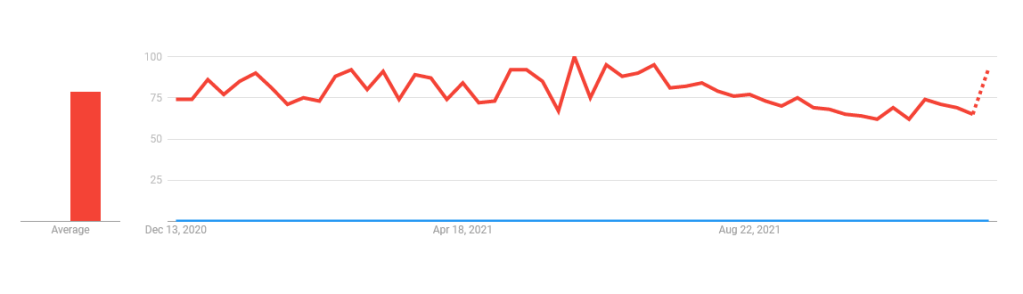
This has had a profound effect on my experiences with both games. If I want some advice which classes in Dungeons and Dragons are generally most effective, I could check here and here. If I want to know the ins and outs on Paladin subclasses specifically, I can check here or here. No similar third-party resources exist for 13th Age that I can find beyond the fine folks in the Discord channel (where I learned a shapeshifting druid is something of a glass cannon.)
I don’t mind that. I like how there isn’t a predefined idea about how players should be building characters (ie. every Fighter, Paladin and Barbarian in Dungeons and Dragons basically being required to take a small selection of specific feats to stay competitive at high levels) and while some talents and powers in 13th Age may be more useful than others, I don’t see a lot of trap choices that could cripple a character.
That said, character creation in 13th Age is more complicated than Dungeons and Dragons. Not only do you customize your character right at first level, but you have to figure out your combat statistics. Here’s how to calculate your armor, for example:
- Find the base AC value for your class (10 to 16) in the Starting Stats for 1st Level Characters chart.
- Find the middle value among your Con modifier, Dex modifier, and Wis modifier. That value is your AC modifier.
- Add the AC modifier to your base AC value.
- Add +1 at 1st level (and increase by +1 at each additional class level).
That’s not difficult arithmetic, but its not intuitive either. In our 13th Age campaign I had my armour lower than it should have been – I think I forgot to add my level – and it almost cost my character his life during a ghoul ambush. (He later died in an attack by a sea wyvern.)
Some character builders are available online, the most comprehensive being the fan-made Toolkit13, but the web version does not calculate your character’s statistics. (Update: the Foundry VTT version does – I’m just taking it for a spin and it’s pretty slick. The system requires a one-time fee for one member of a party, probably the GM, and it seems worth it for most groups.)
On the other hand, I have an app on my phone which lets me roll a Dungeons and Dragons character in seconds. It doesn’t have everything I need to play, but it spits out my hit points, armour, defenses and a basic summary of my class and subclass powers. It’s a useful tool for testing out build ideas.
The other issue is that it’s going to be hard to find people to play with who already know how to play. I’m lucky to have an open-minded group that likes trying new games. You might not be so lucky. You’ll certainly have far fewer options looking for groups online.
Still, I really can’t recommend 13th Age enough. If a game’s worst problem is that it almost has too many good ideas to learn at once, that’s not really a bad thing, is it? Top it off with the fact that the core book is a combination Player’s Handbook, Monster Manual and Dungeon Master’s Guide, this is an easy and inexpensive addition to your RPG library.
 Into the Fray