Inspired by The Athletic’s NBA Player Tiers project, here are my groupings of the best board games I’ve ever played.
All of these are more than “just a game.” I’ve left off some perfectly entertaining games I’ve played, such as Last Night on Earth, Epic Spell Wars of the Battle Wizards: Duel at Mt. Skullzfyre, Traders of Osaka and King of New York, because they don’t quite hold up to what’s listed here.
I judged each game on its own merits. Love Letter is a small, family game so it isn’t going to get knocked down because it’s not as deep as Brass: Birmingham; Brass is meant for people who like challenging eurogames, so it isn’t going to lose points for being much harder to learn. Still, a truly great game has universal appeal.
Writing detailed reasons for all my rankings would be Sisyphean, even for me, but I will give some thoughts on the Tier 1 and Tier 2 entries and what sets them apart. You could make arguments to place many of these games in a higher or lower tier, but I think these groupings are fair. If you have thoughts to share, feel free to hop in the comments.
Here we go!
Tier 4: Something Special
This first group of above average games has a little something extra.
- Air, Land and Sea
- Archaeology
- Ashes: Rise of the Phoenixborn
- Celestia
- Century: Eastern Wonders
- Colt Express
- Dead of Winter: The Long Night
- Epic Card Game
- Exit
- Ex Libris
- Flick em Up
- Fugitive
- Galaxy Trucker
- Hive
- Jaipur
- Machi Koro
- Roll for the Galaxy
- San Juan
- Settlers of Catan
- Shadows Over Camelot
- Sheriff of Nottingham
- Sherlock Holmes Consulting Detective
- Smash Up
- Star Realms
- Through the Desert
- Tzolkin: The Mayan Calendar
- Voyages of Marco Polo
Tier 3: Genre Standouts
From worker placement to area control to games for parties and families, these games are great examples of their genres.
- Burgle Bros
- Cosmic Encounter
- El Grande
- The Fox in the Forest
- Hansa Teutonica
- Isle of Skye
- Kingsburg
- Lancaster
- Lords of Vegas
- Love Letter
- Oceans
- Pandemic
- Skull
- Spyfall
- Survive: Escape from Atlantis
- Ticket to Ride: Europe
- Treasure Island
- Troyes
- Village (with the Inn and Port expansions)
- Whitehall Mystery
Tier 2: All-Stars
These games are among the best at what they do. Players can always expect to have fun.
7 Wonders
7 Wonders asks you one question over and over again: is it more important to take the card you really want yourself or the card you super duper don’t want someone else to have? And it never gets old. This is also the only eurogame you can play with up to seven people and finish before the heat death of the universe.
Arboretum
This is a small, relaxing game about collecting suits of trees and making pretty paths in your tree garden. It’s also a vicious test of card counting and keeping a close eye on your opponents’ gardens while you curse your seven-card hand limit. And it has the best tie-breaker rule in the history of board games: plant a tree and see whose grows taller.
Arctic Scavengers
You look at your hand and see a scavenger, a brawler and a spear. That should be more than enough to claim this round’s contested resource, right? You could even maybe get away with sending your scavenger to the junk yard to look for medicine so you can hire a scout or sniper later. But what if he only finds junk? And then your brawler loses the fight? Screw it, you think. You tell the table you’re holding everything back for the fight and they look at each other nervously. You only hope they don’t realize that two of your cards are useless refugees.
Brass: Birmingham
Brass: Birmingham is a three-hour event of a eurogame. Three different resources, each with different rules for buying and selling them. A mid-game reset of the board where you switch to trains from boats for transport. A finicky tech tree to upgrade multiple types of goods. But all of that is manageable by the fact that each turn, you’re limited to two actions, themselves tied to the dwindling number of cards in your hand. Brass has a lot of rules, but no more than it needs. And unlike some euros like Tzolkin, it’s not simply a case of out-mathing your friends – you’ll all be elbowing your way into each other’s plans.
Citadels
It’s good to be the king. Except when everybody knows you’re the king and want to rob/assassinate you. So maybe it’s better to be the merchant or architect? Except maybe it’s actually better to be the assassin and target the merchant. But is there even a merchant this round? You forget to check, didn’t you? Tsk tsk.
Codenames
A perfect complement to both family gatherings and get-togethers of people who barely know each other. Simple rules create infinite scenarios in which you stare at your partner slack-jawed and say, “how was I supposed to guess that?!”
Conditierre
A simple card game with a tiny country to fight over. It’s like a mini-El Grande and I think it’s better. The ecosystem of cards means there’s always a reason for players to be wary of each other – maybe they have a Bishop to wipe out your high cards, or maybe they’re holding a drummer that will boost all of their weaker cards. But you can’t be too patient, lest they have a key to immediately end the battle while they’re winning.
Libertalia
Nothing in this world, nothing, is as funny as multiple players laying down Brutes and watching in horror at the confused bloodbath over booty that nobody wanted. Well. Maybe it’s a bit funnier when a player plays a monkey to give all their cursed relics to another player, only for that player to have anticipated this and played their own monkey, so that someone on the other side of the table is drowning in negative points.
Mexica
A flawless area control game. Players have the freedom to divide the board however they wish to build zones of specific sizes. They can zip around the island in the ancient equivalent of a jet ski. They can forego actions to plan for an uber-turn later on. But all the while they are engaged in painfully passive aggressive construction within those zones, trying to use just enough of their largest temples to convince everyone else to leave them alone, while plunking as few of their smallest temples as they can to claim second and third place points in other areas of the board.
Mysterium
It’s hard being a ghost. You try all night to lead these silly investigators to the obvious conclusion that the bookcase represents the policeman, the flowers represent the forest and the mouse represents the knife. Except now you’re out of the useful visions and … this card is mostly blue so it will lead them to the blue uniform of the policeman. I guess?
The Quest for El Dorado
This is a new addition to my collection and wow is it good. A deckbuilder where you race through a jungle on the way to hidden treasure and must collect enough cards of various types to get you through different obstacles. It’s rare to find a game this simple that also lets you try so many different strategies. The fact that it comes with multiple suggested layouts of varying difficulty is icing on the cake.
Unmatched
Unmatched vies with Inis for the honour of having the best art of any game in my collection. It’s so damn cool. No seriously, here’s one of the Bigfoot cards:
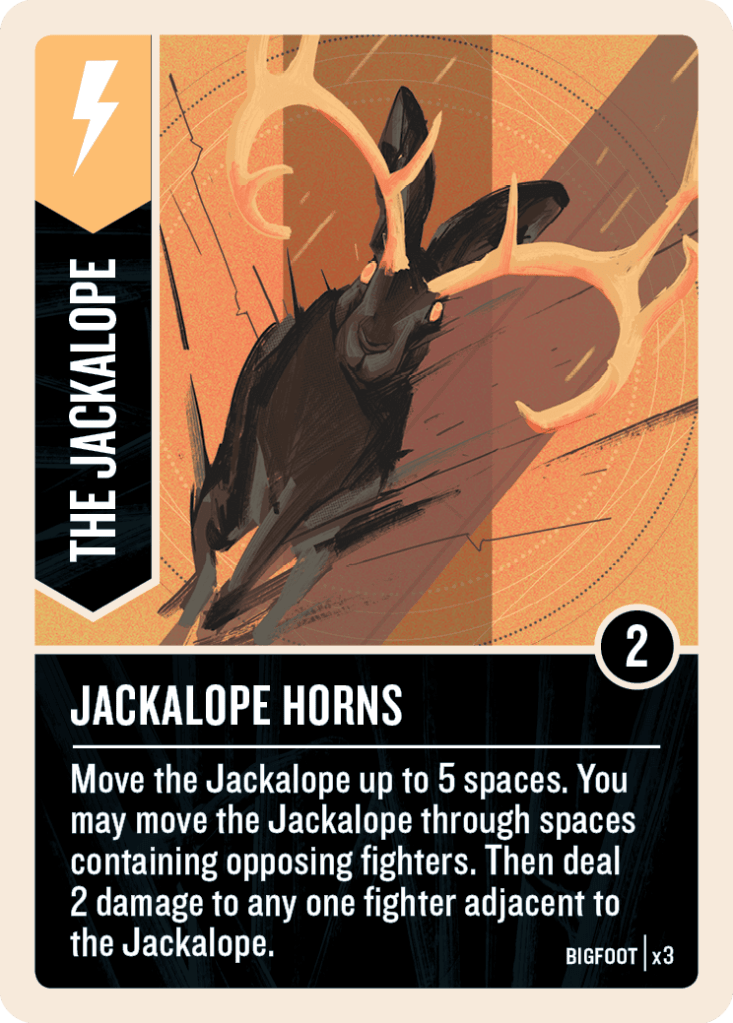
Unmatched is a quick, simple dueling game where each character has a unique mechanic. Sinbad grows more powerful as he plays voyage cards. Medusa can harass you with her minions while she moves in for the kill. The raptors from Jurassic Park boast lethal teamwork. And have I mentioned how good the artwork is?
Tier 1: MVPs
These games are pure joy in a box and are in contention for Greatest of All Time.
Carcassonne
Of the Core Four games that are typically recommended to people new to board games – the others being Catan, Pandemic and Ticket to Ride – Carcassonne is the champion. Unlike Catan, you don’t have to look your friend in the eye and haggle over resources. Unlike Ticket to Ride, you can try out different strategies as you adapt to a changing board. And while the original Pandemic is a whip-smart cooperative game, it won’t elicit the groaning and laughing as in a game of Carcassonne after a player finally finishes the 30-plus point city on which they’ve hinged their entire game.
Concordia
Play a card, do a thing. It’s that simple. And once you learn the function of the cards in your starting hand, you’ve already learned 90 per cent of the rules. Maybe you buy a better card, maybe you trade some resources, maybe you move a ship and build an outpost down in Egypt, maybe you hoover up some of that sweet, sweet Iberian wine. Any decision you make is good and will help score you some points. But is it the best move? Can you really afford to delay expanding your network while your friends are already in three regions? The icing on this particular cake is that if you’re getting smoked, you won’t know until the game is finished and you tally up the points. And if you do end up a distant fourth, it’s clear how you can improve next time.
Cyclades
Cyclades is what Risk wants to be when it grows up. Just keep an eye on that Pegasus.
Dogs of War
Up to five players are engaged in what’s essentially a simple stock market game disguised as the most awful tug-of-war. You place steampunk mercenary captains along with troops of varying strengths on random battles between noble houses. If you play your cards right, you can gain influence among the winning houses while claiming free war machines and running away in a shower of victory points. More likely, you’re be constantly short on cash with just a few decent knights to your name and spinning a hopelessly tangled web of alliance and betrayal with the other players. Absolutely brilliant.
Inis
The spiritual successor to Cyclades. And just as Perfect Dark was to GoldenEye 007, Inis is prettier and trades in simplicity for exciting new mechanics. I love drawing new exploration tiles and adding them to the Celtic dreamscape the players are wrestling over. But as just one example of the curveballs Inis throws your way, it’s the Bren – the player who controls the capital – who decides where the new tiles are placed, not the person activating that action.
Memoir 44
The ultimate two-player game. From simple skirmishes in the woods to storming the beaches of Normandy to a desperate defence of a bridge, the many scenarios in Memoir 44 provide perfect settings for the most rock-solid dice mechanics I’ve ever experienced. From the first turn to the last, you’ll be making interesting tactical decisions based on the imperfect selection of order cards at your disposal.
Pandemic Legacy: Season 1
Season 1 takes the core gameplay of Pandemic and adds countless twists as you play through 12 months of fighting a mysterious new disease. The deck of unpredictable objective cards means you have to throw your typical Pandemic strategies out the window and hope for the best. (Sorry, Shanghai, we just … can’t get there for a month or two. Hang tight.) And just when you think you’ve got it cased, the game literally has you rip up the rules and add new ones as the situation evolves.
 Into the Fray